Amazon Storefront & Product Ecosystem
Establishing Brand Presence within the Amazon Marketplace
I designed Cyber Acoustics’ Amazon presence across the brand storefront, A+ content, and product imagery. This led to a scalable system that clarified product discovery, improved brand consistency, addressed customer confusion, and helped the team produce future content faster. Speaker bars supported by this content have repeatedly appeared among Amazon’s top 10 best sellers in the Computer Speakers category.
ROLES
Visual Brand Strategy, UX Design, Graphic Design, Copywriting
TEAM
Content Review, Technical Lead
TOOLS
Amazon Seller Central, Figma
GOALS
• Scalable design system, Storefront optimized for better UX
• Content designed to reduce customer confusion and product returns
• A clear path for users to human support

Overview
Keeping up with a growing competitive marketplace
Cyber Acoustics’ Amazon presence had to serve shoppers, educators, office buyers, customers looking for product support, and an internal marketing team with limited design capacity.
My role was to redefine Cyber Acoustics’ Amazon presence by creating a unified system across the brand storefront, product imagery, and A+ content.


One product carried across Amazon’s brand storefront, product image stack, and A+ content to create a more consistent shopping experience.
Research & Strategy
Using Data to Refocus the Customer Journey
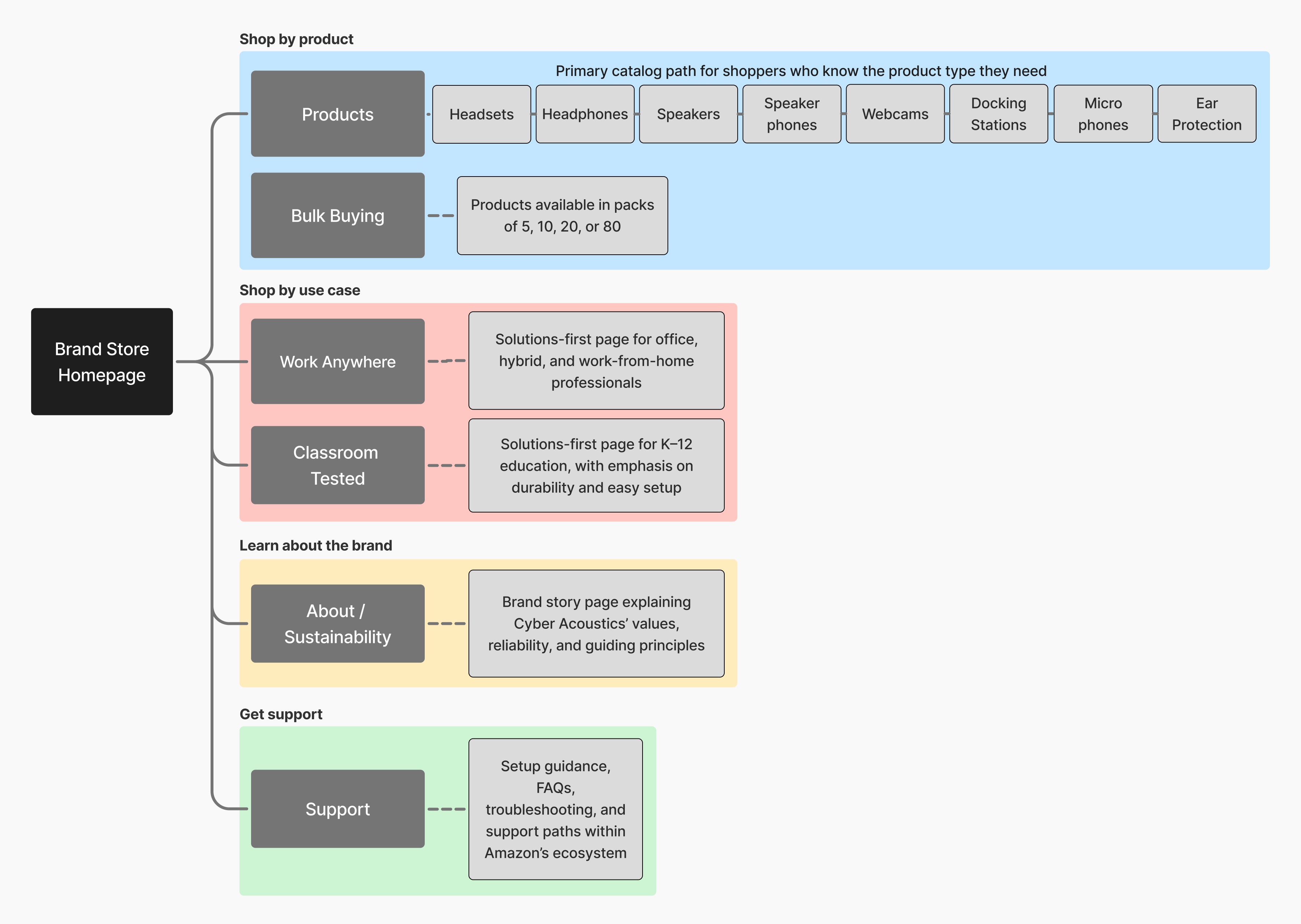
Cyber Acoustics Amazon brand storefront sitemap.
From there, I restructured the navigation around two core audiences: education and working professionals. Rather than trying to speak to every market Cyber Acoustics serves, we narrowed our focus to the customers most likely to shop on Amazon. This kept the content manageable for a small team, while making the storefront feel more intentional and relevant to Amazon shoppers.


Cyber Acoustics’ existing Amazon brand storefront alongside category competitors and non-category storefronts that showcase stronger narrative structures.
My competitive analysis drew from two places. Within the computer peripherals space, I studied Jabra and Logitech to understand industry conventions. Outside of it, I looked at Benebone and Rustichella d'Abruzzo, two companies that use their storefronts to tell a coherent story about who they are and why their products hold value. This helped me define what the storefront needed to do beyond listing products: guide shoppers, communicate value, and make the brand feel more credible.
The audit showed that the storefront needed fewer audience paths, clearer product discovery, and stronger value storytelling.
Constraints
Design Constraints
Whatever we built had to be maintainable. There was no dedicated production team, just a small cross-functional group juggling multiple business priorities, so scalability was a core design requirement from the beginning.


Team-facing A+ guide for faster, more consistent content production.


Working within Amazon's rigid content ecosystem
Amazon’s content restrictions shaped how product value, support, and search visibility could be communicated. I responded by using built-in text modules more intentionally and creating repeatable copy patterns that reduced review friction.
Designing support paths without external links
Amazon's content policies prevented customers from being redirected outside of the platform ecosystem. This made it difficult to direct customers experiencing issues with their products to Cyber Acoustics' in-house tech support, one of the pillars of trust the brand has built up for 30 years.
My solution was to create A+ content that helped with product setup and support, and build out a store page dedicated to driving customers to our tech support agent and the resources we made available on Amazon.

Support page module guiding customers to product-specific setup instructions.

Modules directing customers to product pages for setup instructions.

Maintenance videos gave customers self-directed support inside the Amazon experience.

Setup carousels answered common product questions before they became support issues.
Execution
Brand Store
I redesigned the brand store from the ground up: refreshing the homepage, revising navigation, updating subpages, and adding any missing products back into the storefront. The structure was built to be maintained by a small team without a dedicated designer needing to be involved in every update.


Cyber Acoustics Amazon Storefront homepage, featuring newly released products, best sellers, and modules for Education and Office audiences.
A+ Content & Product Imagery
I created a design system and template structure for all A+ content and product imagery - both to establish visual consistency across the catalog and to make future production faster for the team.
Some modules were designed specifically to address return drivers and recurring support questions. Working with our tech support specialist, who fielded customer questions and wrote responses to Amazon reviews daily, I built content that spoke to common points of confusion around product functionality.

A+ and product image systems used repeatable layouts to explain benefits, reduce confusion, and speed up future production.
Bridging customers to support
One of our core goals was to close the gap between Cyber Acoustics' commitment to real human support and Amazon's restrictions on directing customers off-platform. While the content guidelines didn't change, I designed around the constraint - building A+ modules with clear how-to content and FAQs, and using copy and imagery to guide customers toward the support pipeline that existed within Amazon's ecosystem.
Near the end of the project, Amazon rolled out a feature allowing vendors to include a direct link to their website post-purchase. The groundwork we had laid meant we were ready to make use of it immediately.

Hero module at the top of the Support page calls out local human tech support.
Outcomes
Content supporting top-selling products
The CA-2890 and CA-2890BT speaker bars, both supported by product imagery and A+ content I designed, have repeatedly appeared among Amazon’s top 10 best sellers in the Computer Speakers category. Their continued marketplace performance provides strong commercial context for the content and customer experience work shown throughout this project.
A scalable design system
Templatized A+ content and product imagery that a small team can maintain and build on without starting from scratch each time.


Repeatable A+ content and product image layouts created a consistent structure for future product content, including modules adapted by teammates.
A storefront that tells a story
Clearer navigation, a cohesive visual identity, and a brand presence that reflects who Cyber Acoustics actually is.

Education-focused storefront content translated product durability into clear benefits for school buyers.
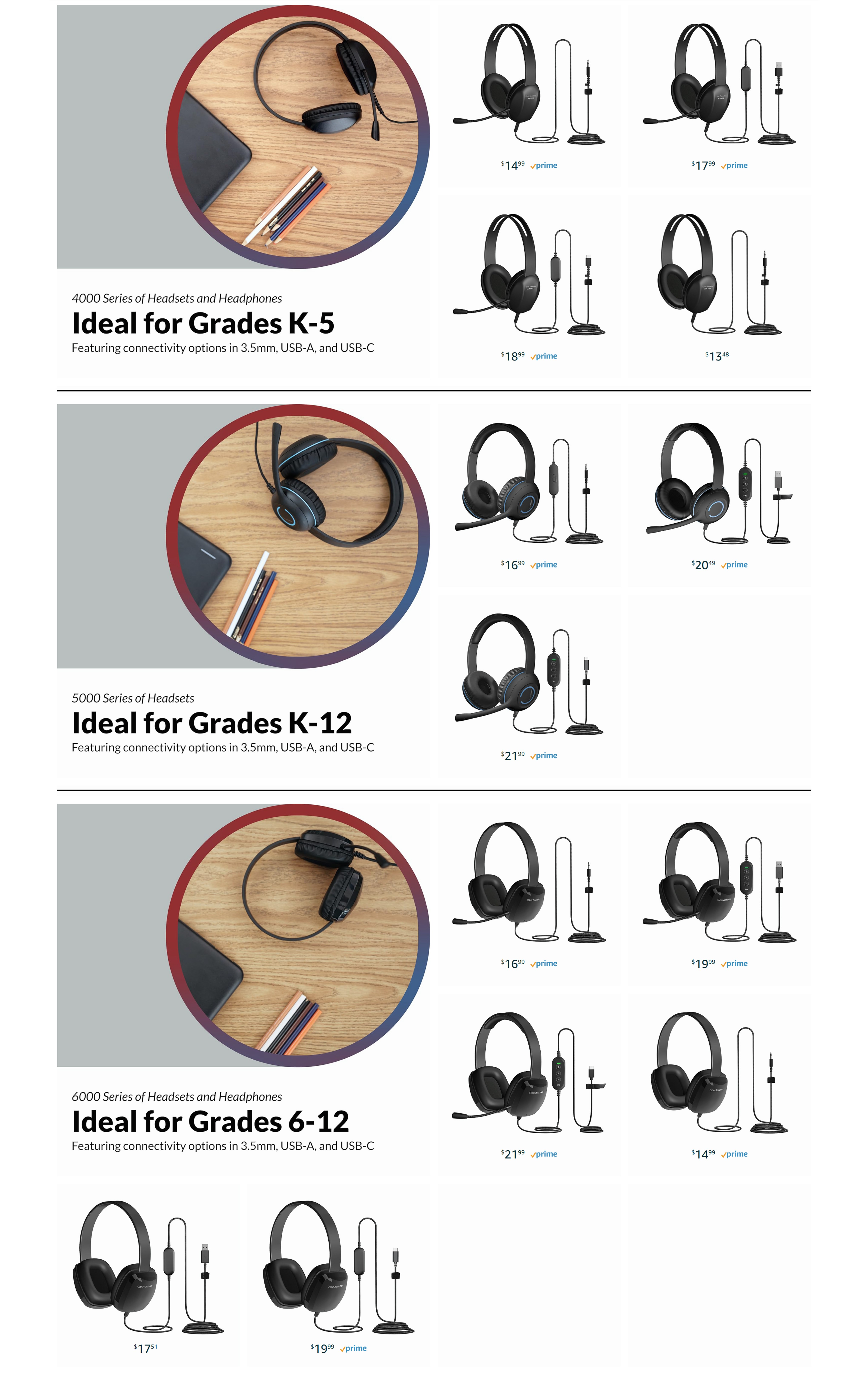
Product families were organized by grade level to make classroom purchasing decisions easier.
Content built to reduce customer confusion
Targeted modules addressed real customer questions and documented return drivers before confusion became a return, review issue, or support request.

Initial setup guidance module with later teammate-adapted variations, showing how the system scaled across products.
A path to human support
Copy and design that directed customers toward support resources within Amazon's constraints. When Amazon rolled out the ability for vendors to link directly to their website post-purchase, the groundwork was already in place to connect customers to real human tech support.

Support content connected customers to setup resources and human help within Amazon’s platform constraints.